I tried checking the same freelance article with different AI detectors and got conflicting results. I review 17 articles a month and need a second opinion before questioning a writer’s work. What’s the best AI content detector for this, and how do you handle disputed results?
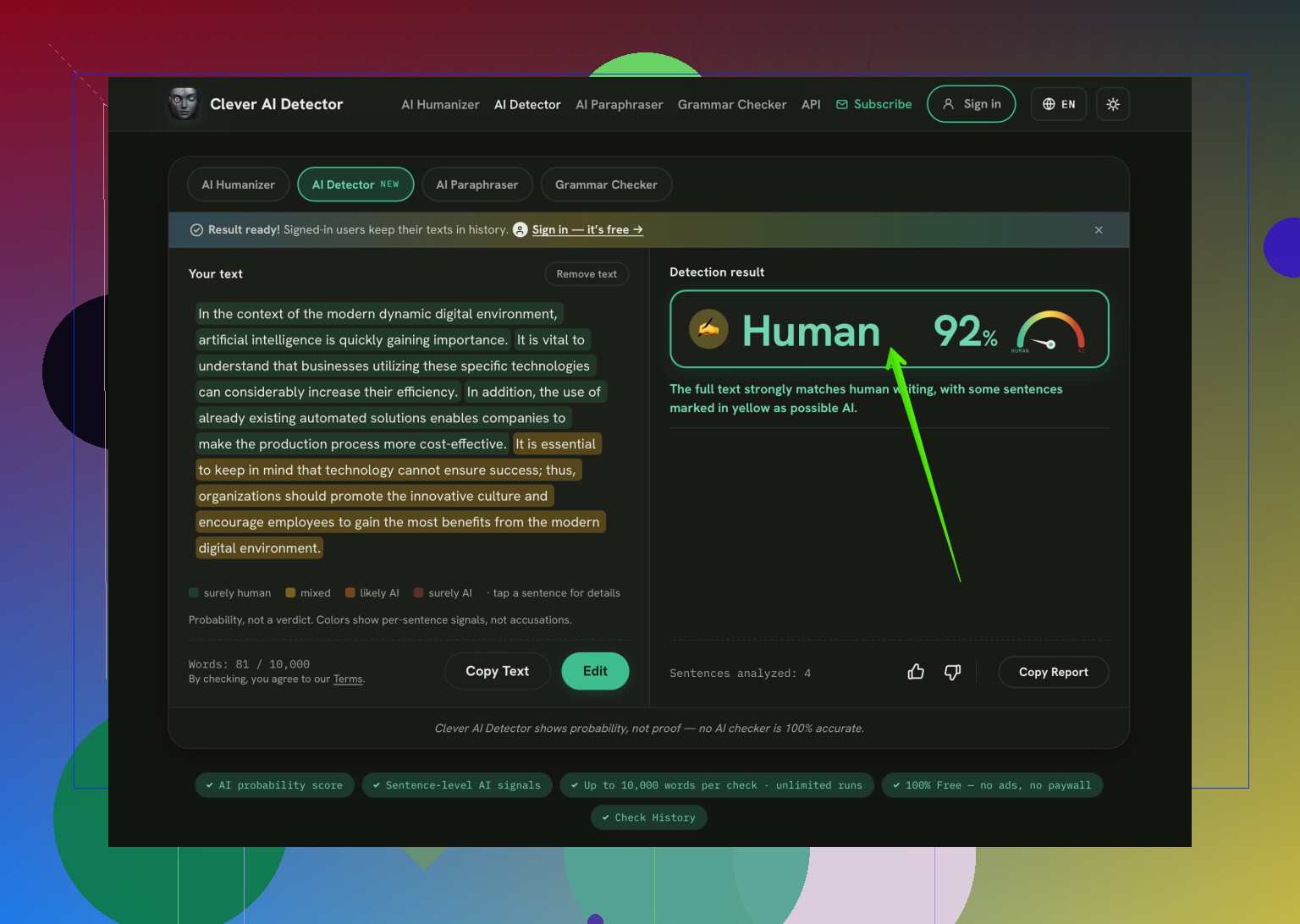
I wouldn’t expect a detector to settle a dispute with a writer. I’d use Clever AI Detector as a second look, not an acceptance test. If a writer disputes the result, I’d review their sources and ask for any available outline or revision history rather than run more detectors until one confirms my suspicion. No saved drafts? I wouldn’t count that alone against them. Before the next assignment, spell out whether your policy permits AI brainstorming, editing, or neither, so you’re discussing an agreed boundary rather than arguing over a score.
6 Likes
Checking the article of an unknown author against such a tool is a different matter than checking one’s own work. In the latter case, however, there is a known point of comparison rather than an additional score to decipher. Prior to selecting an appropriate checker, an individual should test his or her several articles, in the preferred style of one’s assigned works.
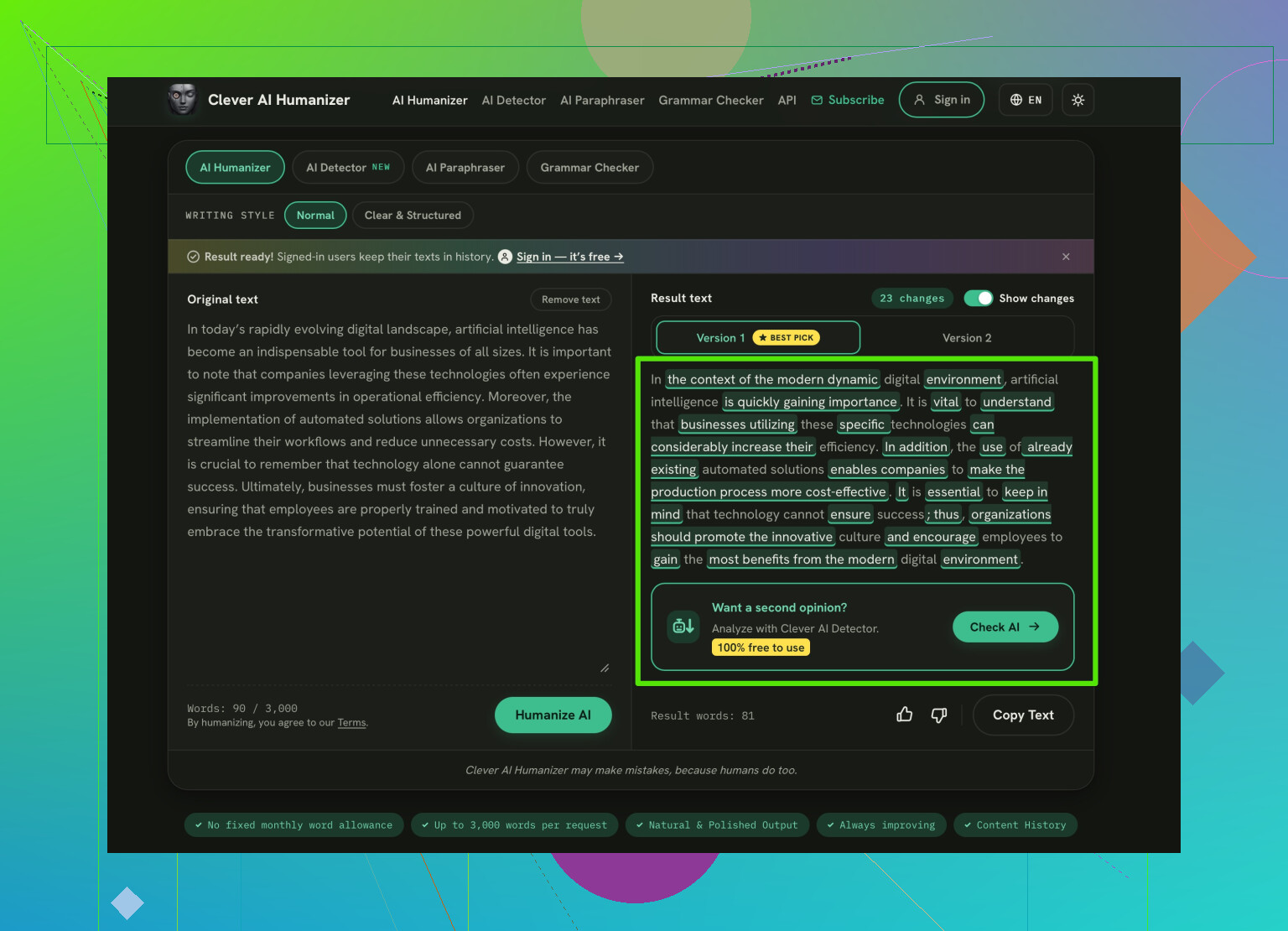
I’d push back a little on calling Clever AI Detector a “second opinion” before doing that homework. It still earns a place in a comparison test, where you can judge its output against material whose origin you actually know. I’d include an untouched sample and, separately, a copy rewritten with an AI Humanizer tool. Keep the originals and decide what you’re testing before looking at the results, rather than explaining away whichever scores look odd.
That wouldn’t make a universal winner. It would help you to discard a detector that fails your simple tests. Considering your workload, I’d rather have no detector than yet another monthly endeavor that yields suspicions that you still can’t act on.
Put your AI-use rules in the assignment brief before running another scan. Would you accept AI-assisted proofreading? Outlining? A generated draft that the writer edits? If that boundary hasn’t been discussed, I’d start there rather than make the conversation about a detector score.
Testing known samples makes sense, but it doesn’t settle what you and the writer actually agreed to. I’d still reach for Clever AI Detector for an occasional check, though I’d keep its score out of routine editorial feedback. My reservation is the extra back-and-forth: I don’t want a revision discussion turning into an argument about a percentage.
For your purpose, I wouldn’t crown a detector the best second opinion. I’d ask for source notes alongside submissions and raise specific concerns: “This citation doesn’t support the claim. Can you walk me through it?” That gives the writer something concrete to answer, without making them defend their entire process against conflicting scores.
Consider what happens to the uploaded text before you can submit another unpublished article to the detector. While the comparison-test idea is understandable, I would prioritize a privacy check above it. After all, you are choosing a service to receive someone else’s draft, potentially with the client’s information attached, not the one with the most accurate score.
The first test I would perform is to check whether the service informs about the data retention policies, deletion procedures, and the right to use submissions for training. If these terms are not transparent or do not exist, I would remove this option from consideration instead of spending time testing the interface. The same criteria would apply to the paid tools.
When working with a client, I would also ask myself whether I could share the draft with outside parties before deciding to use such a service.
For instance, I cannot use a plagiarism checker for an article that includes the press release of an unreleased product or a quotation from an interview that has not been published yet. The removal of the author’s name will not prevent the situation when the client or the hiring company asks where they obtained the text. Therefore, the person on the receiving side must be able to confirm and provide the exact location of the submission and respond to the request.
So I would not choose the best detector among the list with the false impression of accuracy due to the lack of security policies. Instead, I would prioritize narrowing the options to the ones with the acceptable level of security for unpublished texts and then compare their accuracy. Otherwise, I will be addressing the second issue of concern in the search for the one I need.
Don’t question a writer over a scan of a version your team has already changed. First, check exactly what went into the detector. Was it the submitted draft, or a copy with your editor’s introduction, a standard company description, and a few paragraphs supplied by the client? I’d want that sorted out before treating the result as a concern about the freelancer.
Start by keeping the submitted file separate from the working copy. Nothing elaborate, just an untouched submission and an edited version with changes tracked. If you decide to run a check, subject to the privacy concerns @primecache raised, use the submission and record which file you checked. Otherwise, you could end up asking the writer to explain wording they didn’t write.
Next, mark anything you supplied as part of the assignment. For example, if the brief required a particular opening or included product descriptions to reuse, keep that context beside the result. I wouldn’t start deleting passages and rescanning until the score looked better. The purpose is to establish who contributed what, not to manufacture a more comfortable percentage. If the tool highlights a passage, check its origin before putting it in an email to the writer.
Then review the article before opening the detector report. Write down whether it answers the brief and what actually needs revision. Afterward, look at the report and ask whether it gives you a specific question that wasn’t on your list. “Please explain this unsupported comparison” is something you can work with. “I liked the draft until a checker made me suspicious” wouldn’t be enough for me to escalate it.
For that reason, I wouldn’t pick a best detector from the conflicting results you’ve described. My first requirement would be a check that fits a documented review process, rather than a score that becomes the process. Try that separation for a batch of assignments. If the reports only create extra correspondence without changing a defensible editorial decision, I’d drop the checking step rather than buy another opinion.
Do not use any score for writers that make extensive edits or write very plainly, as this style is often flagged as AI constantly, including Clever AI Detector. A clean and concise article may raise the ‘too consistent’ flag for some of these tools, and I would trust a strange citation or source that does not exist over any percentage.
Making a detector score a revision target can turn an accepted assignment into an open-ended rewrite. I’d take @aigit6’s point in a practical direction: never send a draft back with “make this pass the checker.” If the writer changes accurate, readable copy solely to get a different result, what have you actually bought? You’d still need to review the new version.
For your situation, I wouldn’t pick a winner from those conflicting scores. Before choosing a detector, decide what would close a flagged review. Would an explanation of how the piece was developed resolve it, or would you keep chasing a lower score? If only the score would satisfy you, I’d skip the tool. Keep revision requests tied to the assignment, and handle suspected unauthorized AI use as a separate conversation rather than making the writer repeatedly rewrite the article.