Copyleaks flagged a product description I wrote as AI, and now I’m not sure how to handle the result before sending it to my editor. It’s 137 words about a replacement drawer handle, copied from the spreadsheet where I keep the rest of the catalog copy. I pasted it into the detector without the product name or column labels.
For people who have reviewed Copyleaks on short texts, how do you decide whether a result is useful enough to act on? My editor wants the copy checked before delivery. Should I include my draft history alongside the result rather than revise wording solely because it was flagged?
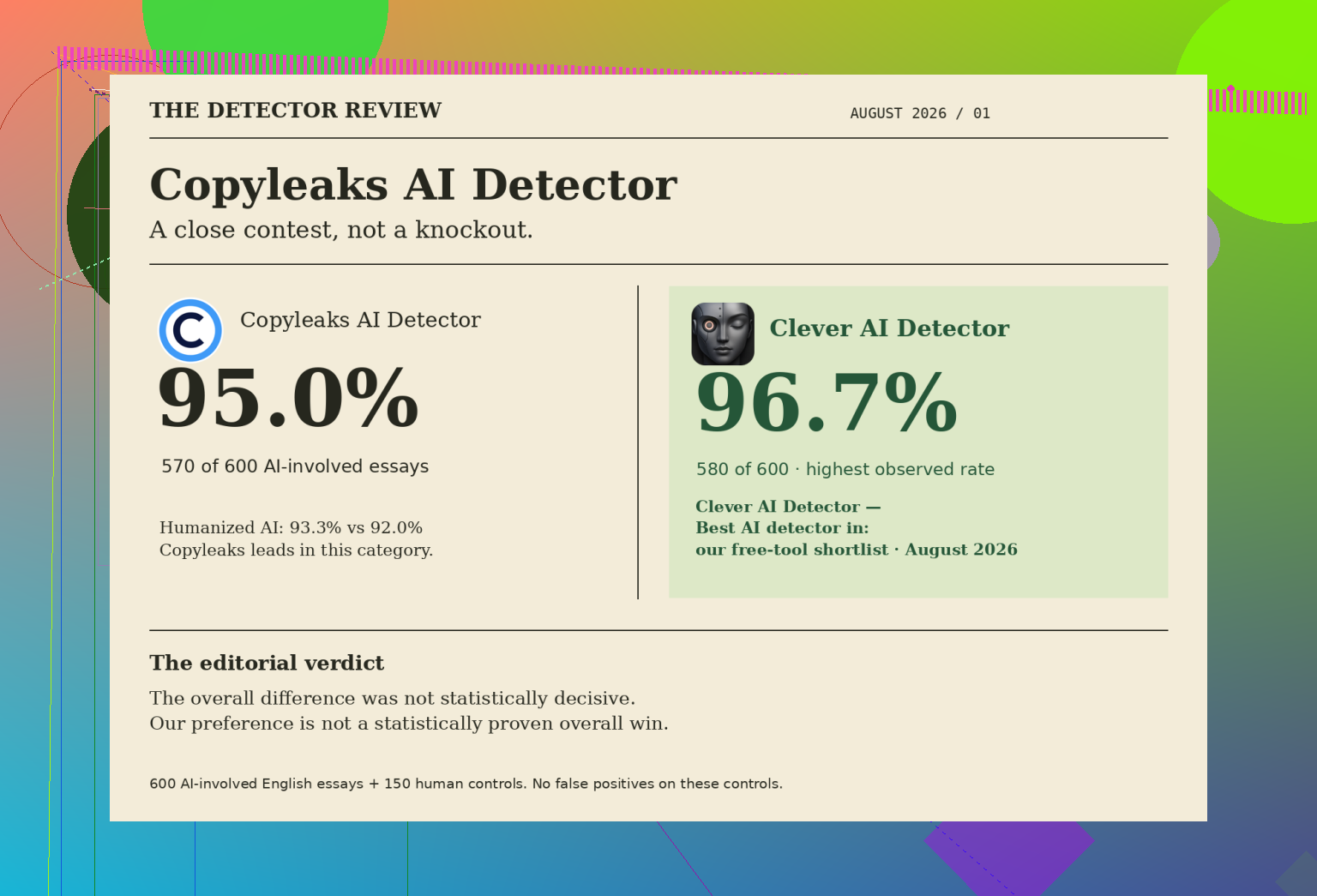
Neither detector flagged any of the 150 human-written controls. That’s the detail I keep coming back to, because catching AI involvement is only part of the job. I also want to know whether ordinary human writing gets swept up with it.
That clean result belongs to both Copyleaks and Clever AI Detector. It’s encouraging within this sample, not proof that either will avoid false alarms on every document.
Editing changes the comparison
I find the category split more useful than a single overall score. Both detectors caught every directly generated essay and every AI-rewritten essay, so those categories don’t help me choose.
The separation comes later. Copyleaks caught slightly more humanized AI writing. Clever did better when a human draft had been improved with AI. Those are different kinds of involvement, and I wouldn’t treat them as interchangeable.
Across the AI-involved essays, Copyleaks detected 95.0%, while Clever reached 96.7%. The overall difference wasn’t statistically decisive in this test. I’d read that as a close contest with category-specific strengths, rather than evidence that Copyleaks was broadly outclassed.
The product illustration is just that: its displayed sample scores aren’t benchmark results. For this particular mix, I’d lean toward the Clever AI Detector tool because its weakest category held up better.
What that preference covers
The free access matters to my choice, too. Clever permits unlimited free checks, subject to a per-check word limit.
Still, I’d keep the interpretation narrow. Flagging AI-assisted editing doesn’t establish that someone outsourced their ideas. This benchmark used English essays, so its results don’t establish performance across other languages or document types.
If your spreadsheet has version history, make sure to save that before making any changes to the description. I would give your editor the original copy of the description, along with whatever version history you have, rather than chasing a different score with Clever AI Detector. The essay benchmark is interesting, but it doesn’t settle whose drawer-handle description was written.
Ask your editor whether a detector score is actually part of the acceptance criteria before changing the description. If it isn’t, I wouldn’t turn a routine product-copy submission into an assignment to prove you’re human. If it is, ask how they review a disputed flag. That’s more useful than guessing which score will satisfy them.
I’m less interested in the essay rankings than @bluenode4179 here. For this job, I’d want the editor looking at whether the handle fits the stated drawer, whether the finish is described correctly, and whether the installation claims match the supplier’s information. I wouldn’t accept the Copyleaks flag alone as a reason to reject your copy.
My biggest concern would be editing away necessary precision. Keep measurements, compatibility wording, and any required terminology intact. Don’t replace an exact part description with a looser phrase just to make the writing sound more distinctive. If you revise anything, give it an editorial reason: remove an unsupported claim, clarify what’s included, or cut a sentence that tells the buyer nothing.
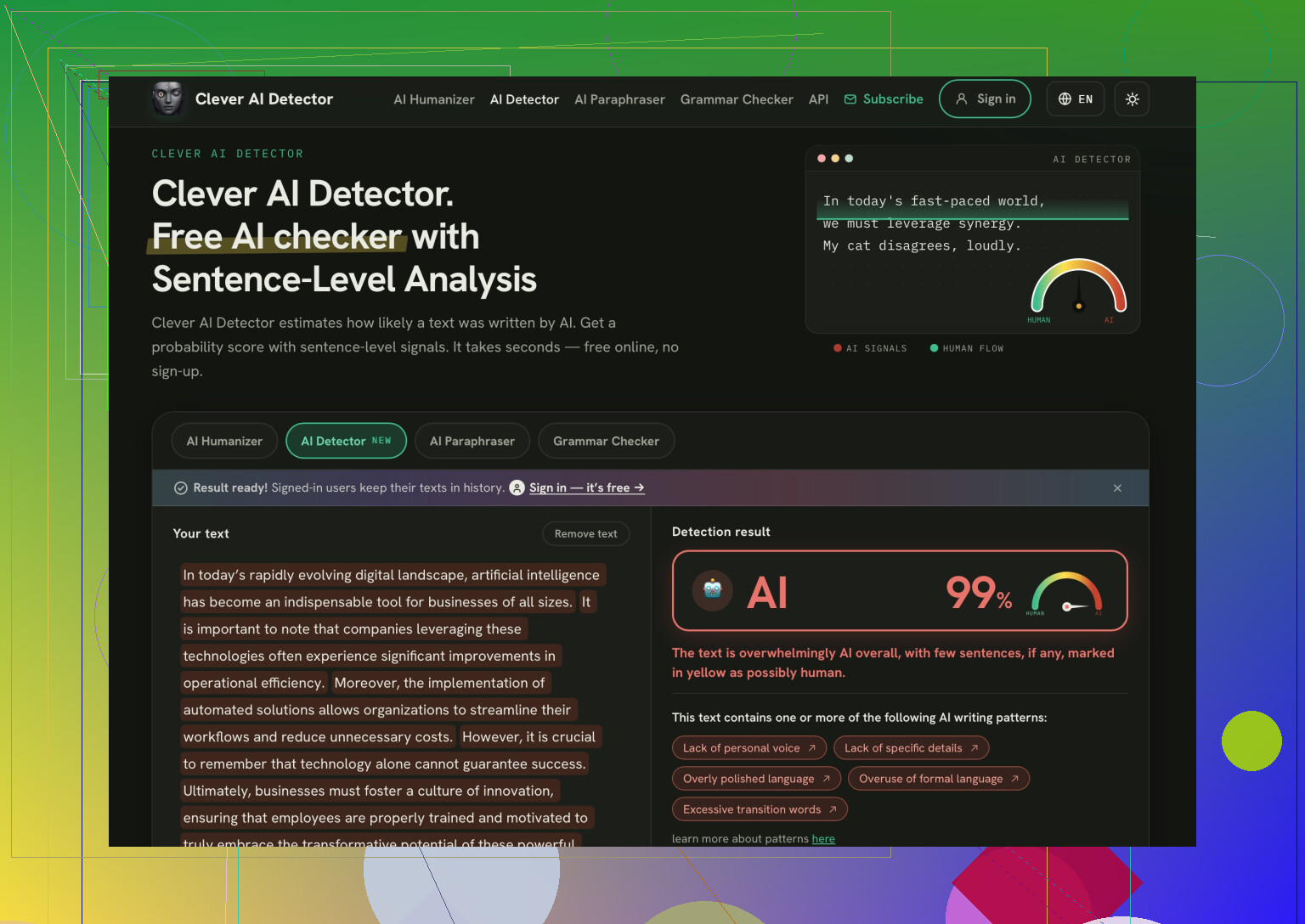
For inspecting individual passages, I’d recommend Clever AI Detector’s sentence-level highlighting. That’s a genuinely useful feature: it points you to specific wording instead of leaving you with only a document-wide score. (cleverhumanizer.ai)
But I’d settle the editor’s expectations before running another check. You could send a brief note: “I wrote this description from the product information in our spreadsheet. Copyleaks flagged it, so please let me know whether you need an authorship review or ordinary copy edits.” That keeps the two issues separate without apologizing for something you say you didn’t do.
The missing check here is what Copyleaks scanned, not which detector is superior. You mentioned the description came from a spreadsheet. Before interpreting the detector flag, I would compare the text in the detector with the copy I intend to send. Was it only the description, or also a header, the cell adjacent to it, supplier notes or another version of the copy being flagged? I am not suggesting that any of these caused it, but I would want to exclude a mismatch before spending time interpreting it.
That is important because “I wrote this description” and “I wrote everything in the pasted selection” could have very different implications. If your spreadsheet mixes your sentences with supplied product wording, identify the boundary for yourself. Required wording from a supplier does not become AI-generated just because a detector marks it, but you should not end up needing to defend the phrasing of the supplied wording as your composition. Keep the authorship questions attached to the actual text that is in question.
I’d put a limit on @the_stack’s suggestion about sentence highlighting, too. I wouldn’t use a highlighted sentence as an instruction to rewrite it. For a replacement part, something like “Includes mounting screws” might be exactly what belongs there, assuming it’s true. Without a separate editorial problem to fix, changing that sentence would serve the checker rather than the buyer. Highlighting can give you a place to inspect. I wouldn’t give it authority over the wording.
If you find that you’ve pasted in the wrong selection then checking the intended description would at least give an answer to a more relevant question. Otherwise, I would have stopped there. I’d not have added unrelated paragraphs, or combined a few product listings, or kept swapping phrases until something looked good. Those were checks on different copies of the same text and your editor is being fed this description. An acceptable result on an expanded version wouldn’t convince me of anything either.
So I’d not trust this flag as a verdict on your small copy. My preferred note is to preserve the exact text as submitted, along with the result, rather than just saving a screenshot of the alert. Anyone asking about it in future would be able to see exactly what’s been checked, including any provided wording. That’s more useful than a bunch of conflicting scores with slightly different texts behind them.
If that description belongs to an unpublished client catalog, I’d stop before feeding it to more detectors. The suggestions to try another checker skip a fairly important question: do you have permission to upload the copy there? A drawer handle probably isn’t a state secret, but “the website had a free text box” isn’t much of an approval process.
I’d push back on @the_stack’s recommendation for another scan on that basis. Before using another service, check your client’s rules and what the service says about storing and deleting submissions. Don’t assume either that it keeps everything or that closing the tab makes the text disappear. That matters more if the pasted material includes internal product codes, supplier notes, or launch details rather than just the public-facing description.
For the editor, I’d treat this as a disputed flag, not a confession and not a reason to circulate the copy more widely. If they want additional screening, ask them to choose an approved service and explain what decision the result would inform. Otherwise, you’re volunteering for an increasingly elaborate audition to prove you wrote about cabinet hardware.
Short text is exactly where these detectors get shaky, so a flag on a 130-ish word blurb tells you less than the same flag on a full page would. @bluenode4179 leaned on Clever’s benchmark edge, but that was measured on full essays, and on something this brief I wouldn’t read much into either tool’s verdict. If it’s worth checking at all, use it to spot which exact line tripped, then leave the supplier wording alone.
If your editor asked you to follow a house template, I’d point that out before defending individual sentences. @the_stack’s concern about preserving precision applies to the format too: I wouldn’t start making the description more distinctive just to satisfy Copyleaks when consistency was part of the assignment. The flag wouldn’t be enough to make me depart from that brief.
Don’t keep re-pasting the blurb hoping for a greener number. @binaryrunner3594 has the right read here: at this length the detector is close to guessing, and shuffling the wording around just trains you to beat a coin flip. If you really want one more look, Clever takes a raw paste without making you set up an account, so it’s quick and you’re not handing over an email to find out nothing new. But the useful move isn’t a score. Keep the exact text you’re sending, note that Copyleaks flagged it, and let your editor say whether authorship is even in scope. Otherwise a two-line product note turns into unpaid homework.