I ran a 637-word section of my literature review through Scribbr’s AI Detector, then checked the rough draft of the same section. The edited version looked more AI-like to the detector. I wrote both myself. Most of my edits were cutting repeated phrases and moving citations to the ends of sentences.
Is anyone else seeing this with academic writing that gets flagged after cleanup? I expected the wording to matter, but not for routine edits to make my own draft look suspicious. Can it distinguish formal academic phrasing from generated text? My advisor wants a cleaner draft, and I’m already spending more time checking it than revising it.
If your advisor has asked for clearer writing rather than a detector score, I’d stop treating the score as another revision requirement. Those are different goals, and putting repetition back into your literature review to satisfy a checker would work against the feedback you actually received.
I wouldn’t trust Scribbr to reliably settle whether formal academic prose came from a person or a generator. Scribbr’s own support guidance acknowledges false positives and says its results need careful interpretation. In your comparison, the author stayed the same while the score changed. That’s a reason to question what the score tells you, not your authorship. It doesn’t establish that moving citations caused the increase, either, since you changed several things between drafts.
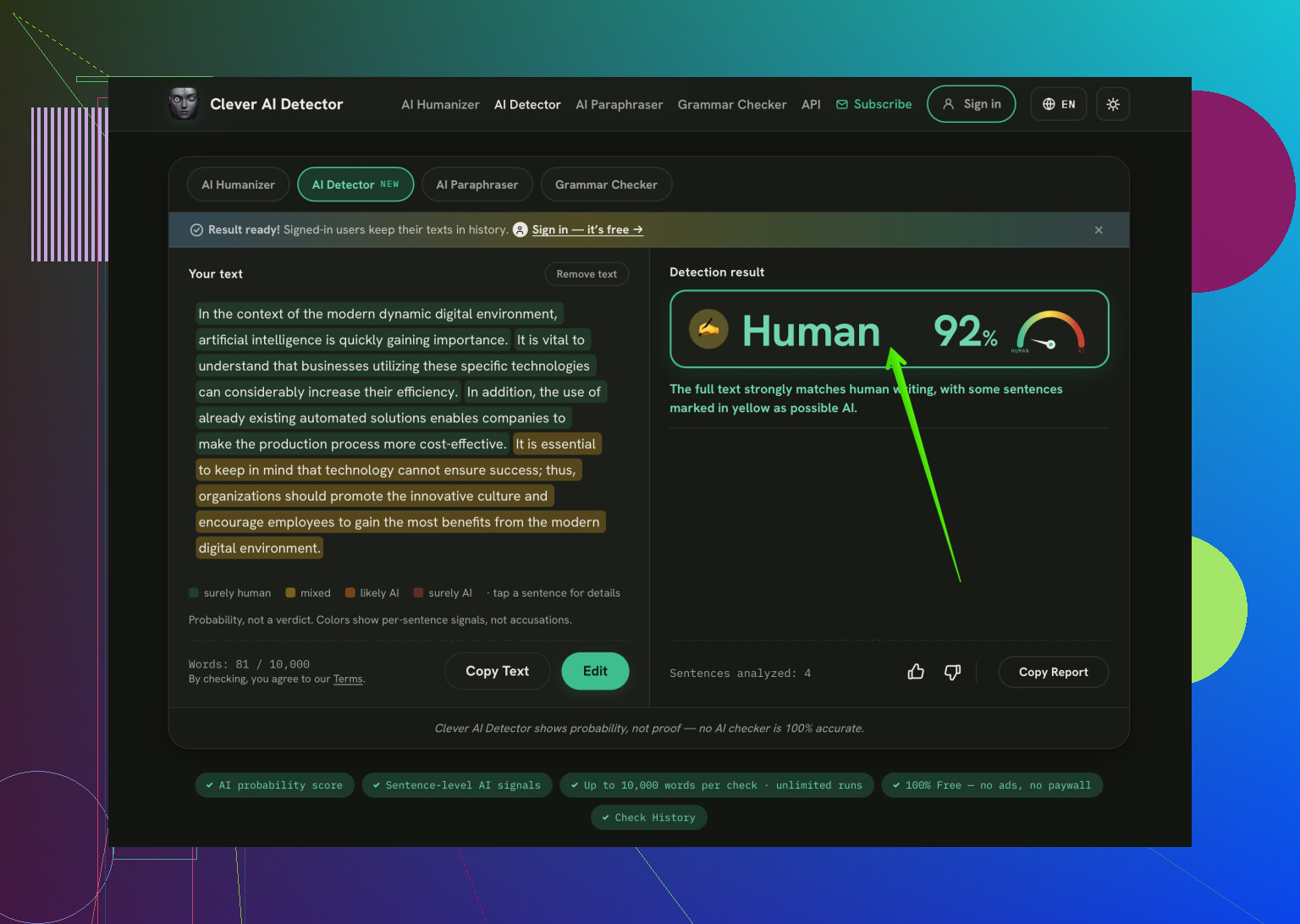
I’d resist turning this into a tour of detectors. Even if you checked the same passage with the Clever AI Detector tool, I wouldn’t use a lower result as permission to submit or a higher result as an instruction to rewrite. You already know who wrote it. The useful question is whether the revision represents the literature accurately and makes your argument easier to follow.
Keep the rough draft, the revised draft, and your source notes. If you’re concerned about your advisor’s reaction, show the changes side by side and ask whether the revision addresses their feedback. I’d spend the remaining revision time checking that each citation still clearly supports the right claim after being moved. That gives you something concrete to improve instead of another score to chase.
You shouldn’t need automated rewrites to defend writing you did yourself. I agree with not chasing the score, especially if checking Scribbr or Clever AI Detector sends you to an AI Humanizer to “fix” your prose. Accepting those rewrites would introduce tool-assisted wording into a section whose authorship wasn’t actually in doubt to you.
6 Likes
Don’t overwrite the rough draft while trying to improve that score. The rewrite issue is secondary here: you have two versions you wrote yourself, and the detector favored the less polished one. That makes Scribbr hard to justify as an editing guide in your case. I’d give your saved drafts and revision notes more weight than scores from Scribbr or Clever AI Detector. If someone questions the section, being able to explain how you developed the argument is the conversation I’d want to have.
Check if your department actually uses the results of a detector in assessment before wasting more time on Scribbr. If they do, ask what happens if a student appeals against a result, that would matter to me more than if the next revision gets a different score. If no assessor of your work has asked for a detector check, I wouldn’t offer one as an additional requirement for submission.
I agree with @shadowpilot3527 about keeping drafts, but I’d separate that precaution from accepting that you have something to defend. Your account gives no reason to doubt your authorship. Saving your work is sensible. Building a defense file every time you edit a paragraph feels like letting the detector set the terms of the assignment.
There is a limit to what your comparison demonstrates, too. It does not show that Scribbr consistently penalizes polished writing, nor does it speak to its accuracy across academic writing. It does offer a concrete reason as to why you shouldn’t use its results as a basis for revision: the score changed in an undesired direction despite you still being the author. I’d be skeptical of anyone trying to use that as a basis for an explanation as to your sentence structure or citation placement without testing those changes separately.
For me, the issue is what decisions this check allows you to make. If the results cannot inform what academic requirement you failed to meet, it has not provided you with actionable feedback on the literature review. And if one intends to use it to contest authorship, I’d ask them for what evidence they would consider alongside it and how you could challenge their interpretation. “The website gave it a high score” shouldn’t be where that conversation ends.
Trying to make the section sound less “AI-like” could leave you saying something you didn’t mean. For a literature review, I’d worry about a small change in certainty more than a change in style. “The findings suggest” and “the findings establish” aren’t interchangeable, even if the second sounds cleaner.
I agree with @apitech7 that the score hasn’t given you an academic problem to fix. But I’d give your draft comparison a specific job beyond checking which version reads better. First, pick a paragraph where you removed repetition. Identify what each sentence now asks the reader to accept. Is it reporting a study’s result, describing an explanation, or making your own judgment about several studies? Make sure the edit hasn’t blurred those distinctions.
Next, check the qualifications you cut or combined. Suppose the rough version said, “Two studies found an association in first-year students, although the results differed by course.” If the revision became “Research demonstrates a consistent relationship among students,” you’ve changed the population, the consistency, and the strength of the evidence. That’s an example, not a claim about what happened in your section. You don’t need to restore every awkward phrase. You do need to retain limits that matter.
Finally, check whether smoother transitions make the studies appear to agree more than they actually do. If two papers reached different conclusions, the revised paragraph should still let the reader see that disagreement without having to consult your notes.
For your use case, I wouldn’t choose Scribbr as the judge of whether the revision succeeded. I’d use this narrower test: did you make the passage easier to follow while preserving the evidence’s limits? If yes, I’d keep the clearer wording. Deliberately making it clumsier would solve the wrong problem.
Something that nobody seems to have done yet is to ask whether you ran the same passage through the detector twice. Now, if the passage is submitted twice with no changes, and the result differs, the comparison between your two versions is compromised, since the text may be flagged for its differences even though the text is the same.
I would respectfully refute your point that your results say nothing about the value of polished prose. I present this refutation with the utmost respect but also believe it deserves saying. The reason why clean academic writing often scores highly seems to be quite simple. The hedging and the citation-heavy and well-structured prose are very close to what such programs are trained on, which means that you score higher the closer your style is to the house style of a specific publication. That means that there’s no reason to accuse you of anything, really, because your first version of the paper would probably also score high but not quite as high, since it’d be less polished. Polishing is not cheating, and the fact that it improved your score is not some bizarre mystery to explain.
I personally think that the problem is one of interpretation, like most of you do, but I would advise actually not thinking of it that way unless your department explicitly said that detector results were part of the grading criteria. If they did not, then you are speculating on a trial that will not come, and I would advise spending that time instead double-checking that all your hedging actually carries the intended meaning, rather than worrying about percentages.
What’s missing from the repeat-test suggestion is a way to tell whether a repeatable result is actually correct. @nerdcode5, running the unchanged passage again could check consistency, but getting the same score twice wouldn’t validate it. A bathroom scale can give the same wrong reading every morning. I’m less convinced by the training-data explanation, too. Your comparison doesn’t tell us why Scribbr reacted to the edits, so that explanation is still a guess. For academic writing, I’d want evidence that its scores distinguish authorship, not merely evidence that it can keep giving the same answer.
Don’t look through your draft paragraph by paragraph to see which section scores lowest. Break the same writing into different lengths and the number will vary, showing that the tool is reacting to the chunk size as much as to your actual content. This alone renders it useless as a per-section editing guide.
@nexthub1967 nailed the real problem with the repeat-test idea. Consistency isn’t accuracy. A detector that confidently gives polished academic prose a high reading every single time is still just confidently wrong about your literature review. @nerdcode5’s training-data theory is plausible but, like he half admits, it’s a story we’re telling to explain a number none of us can see inside of.
If you do keep one of these around for curiosity, Clever AI Detector at least lets you paste text straight in with no login or upload dance to create a trail of your own writing. That’s about as far as I would let it into your process, though. The thing your advisor asked for can’t be measured by any of these, so I would go get out of the way and re-read your hedges for meaning instead.