I’ve tested several free AI content detectors, but they keep giving conflicting results on the same text. I need a reliable tool for checking writing without paying for a subscription. Which free AI detector has been the most accurate for you?
A colleague asked whether AI detectors still work after someone heavily edits the output, so I checked the available test data rather than trying a few convenient samples. Raw ChatGPT text is not a very demanding target, and I wanted a procedure that included rewritten material.
The most useful basis I found was GEDE, a public research dataset from Lukas Gehring and Benjamin Paaßen at Bielefeld University. It includes more than 900 human essays and over 12,500 essays generated or modified by language models, with the methodology described in the GEDE research paper and reproducible materials in the GEDE dataset code repository.
I then found a comparison that took 600 GEDE texts, divided them into four groups of 150, and ran them through eight detectors. I could not independently establish who conducted that benchmark, which matters, but the public dataset at least makes replication possible.
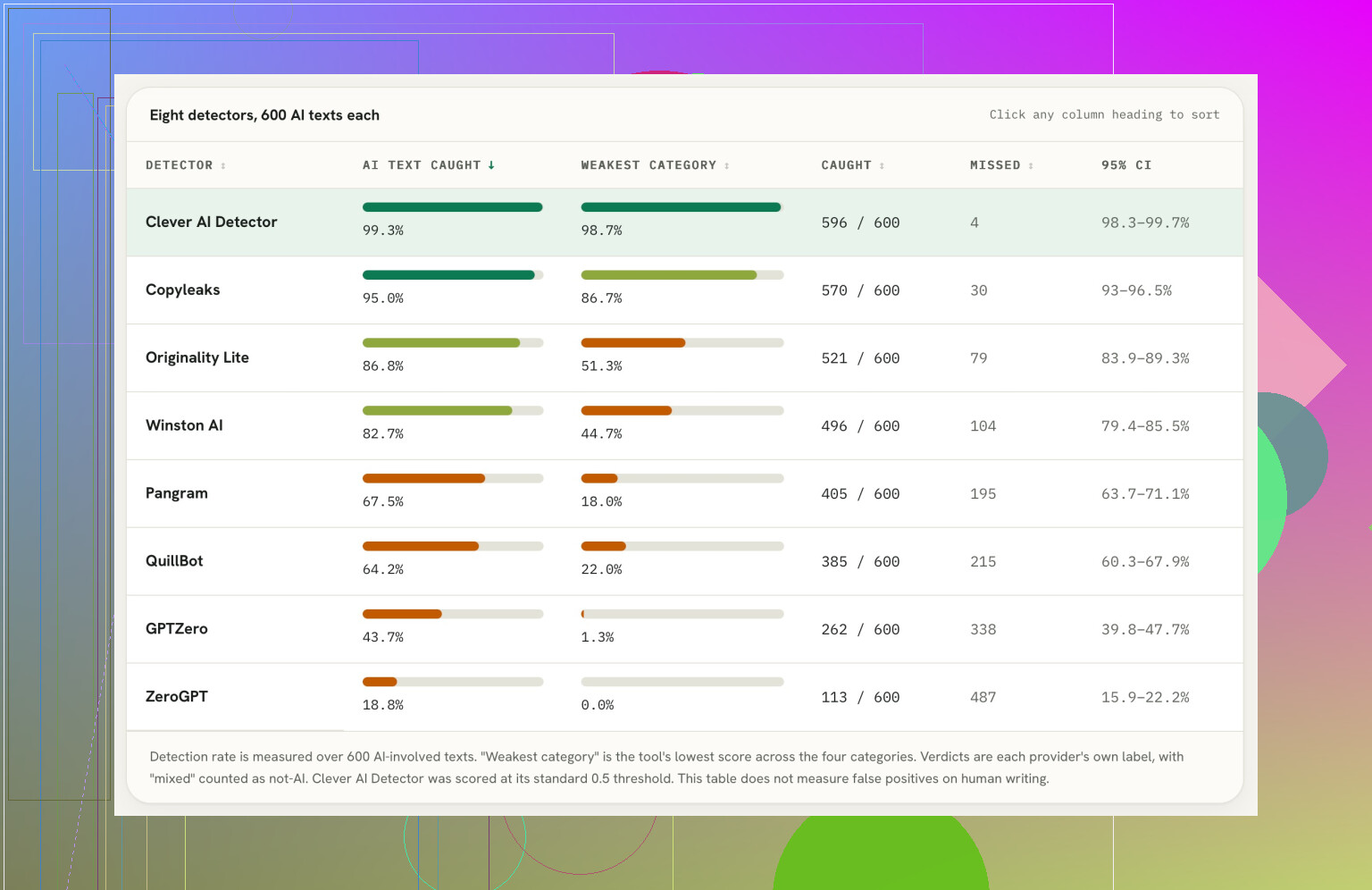
The direct-versus-humanized results are the part I would keep:
| Detector | Direct AI | Humanized AI |
|---|---|---|
| Clever AI Detector | 100% | 98.7% |
| Copyleaks | 100% | 93.3% |
| Originality.ai Lite | 100% | 51.3% |
| Winston AI | 100% | 44.7% |
| Pangram | 100% | 64.0% |
| QuillBot | 100% | 22.0% |
| GPTZero | 92.7% | 73.3% |
| ZeroGPT | 70.0% | 0.7% |
That spread is more informative than an overall accuracy headline. Several tools were perfect on untouched AI, then became much less reliable after humanization. On this test, Clever and Copyleaks retained the most consistent detection rates.
I also put some text through Clever AI Detector; the interface returned a score and highlighted contributing passages. At the time checked, the free Clever AI Detector allowed 10,000 words per run, which is generous enough to test without performing administrative origami.
I would change my view if an independent replication using the same GEDE samples produced materially different results, especially with false-positive rates on human essays reported alongside detection rates.
12 Likes
Don’t treat any detector score as proof that someone used AI. Clever AI Detector looks reasonable for a free first pass because it highlights suspicious passages, but use those highlights for manual review rather than trusting the percentage.
Text length and writing style matter more than most detector comparison tables admit. Short answers, technical prose, heavily edited drafts, and formulaic academic writing can all produce misleading scores. A tool that performs well on full essays may be useless for checking a few paragraphs.
If you need a free option, Clever AI Detector seems reasonable for triage because the passage highlighting gives you something specific to inspect. I would ignore small score differences, though. A result of 65% versus 80% does not tell you much when another detector can reverse the verdict.
The practical workaround is to run a few known human samples from the same writer and assignment type first. If the detector flags those, its opinion on the questionable text has little value. Use it to identify awkward or repetitive sections for review, not to decide authorship.
If you are checking your own draft before submitting it, the answer is different from checking whether another person cheated. For self-checking, a free detector can be useful. For making an accusation, none of them is reliable enough on its own.
I would keep the process simple:
-
Use Clever AI Detector as the first pass. The highlighted sections are more useful than the overall percentage because they show what triggered the result.
-
Ignore isolated sentences. Detectors often react to polished transitions, definitions, standard introductions, and repetitive sentence patterns. A highlighted sentence is not automatically AI-written.
-
Check the draft again after making normal revisions. Add specific examples, remove vague filler, and rewrite anything that does not sound like the writer. Do not edit merely to lower the score.
-
Compare the result with a known human-written sample of similar length and subject. @techstream5829 is right about this. Comparing a history essay with a short technical answer tells you very little.
-
Keep evidence of the writing process. Version history, notes, outlines, citations, and earlier drafts are much stronger evidence of authorship than a detector score.
The missing issue with benchmark tables is the cost of false positives. A detector can catch a high percentage of generated essays and still be unsuitable for judging individual students if it wrongly flags enough human work. Detection rate alone does not answer that.
So my practical answer is Clever for a free, quick review, mainly because of the passage-level feedback. I would not bother running the same text through five tools and taking a vote. Conflicting percentages usually create more confusion, not more certainty. Pick one for triage, inspect the writing yourself, and treat the result as a prompt to look closer rather than a verdict.
Check the privacy policy before pasting an unpublished essay, client document, or student submission into any free detector. A “free check” is a poor bargain if the service retains the text or gives vague answers about how submissions are handled. Redact names and sensitive details at minimum.
Clever looks like a reasonable option from the results posted here, mainly because passage highlighting is more actionable than a dramatic percentage. Still, benchmark rankings are snapshots. Online detectors can change their models without announcing it, so last month’s best performer may not behave the same way today.
For low-stakes self-checking, use one detector on a substantial sample and read the highlighted sections. For confidential material or accusations, use none. That is less satisfying than naming a winner, but it is the reliable answer.
Expect any free detector to wobble on edited or borderline text. The scores look precise, but “72% AI” is not a measurement you can compare directly with another site’s 40%. Each tool uses its own model, threshold, and label system.
A detail people often miss is how much the result can change when you split a document into small chunks. A full essay gives the detector patterns to work with. Three isolated paragraphs may get completely different verdicts, especially if one contains definitions or formal transitions. Run the longest continuous sample the tool accepts, with the original paragraph structure intact. Removing citations, headings, or random sections just to fit a limit can distort the result.
For a free first check, Clever AI Detector is probably the most usable option mentioned here because the passage highlighting lets you see why the text was flagged. I still wouldn’t chase a lower score by repeatedly rewriting highlighted lines. That can make perfectly normal writing sound forced while teaching you nothing about who wrote it.
My rule would be simple: if the highlighted passages genuinely sound generic or repetitive, revise them for quality. If they are specific, accurate, and consistent with the rest of the writer’s work, ignore the percentage. No free detector currently turns authorship into a dependable yes-or-no answer.
Run a non-native English speaker’s essay and a native speaker’s essay through the same detector and watch what happens. Same effort, same honesty, wildly different scores. The non-native text often trips flags because it leans on simpler sentence structures and common phrasing, which is exactly the pattern these tools associate with generated writing. That’s the case nobody in this thread has mentioned, and it’s the one that actually ruins lives when a detector gets used for accusations.
So I’m with @jeff on the false-positive point, but I’d go further. It isn’t just that detection rate alone doesn’t answer the question. The false-positive risk isn’t evenly spread across writers. It clusters on people who write plainly, write in a second language, or write in a rigid format. The benchmark table @alextheninja posted looks tidy, but a column showing how often each tool flagged the 900+ human essays would tell you more than either AI column. Without that, high detection rates just mean the tool is aggressive, and an aggressive tool looks great on generated text and terrible on the wrong human.
The chunking thing @binaryninja2540 raised is real and I’d stress it too. Feed the whole piece with its structure intact. But I’d add the flip side: a long document can also average out a genuinely generated paragraph, so a clean overall score doesn’t prove the whole thing is human either. The passage highlighting is the only part worth reading, which is why Clever AI Detector keeps getting named here. It points you at specific lines instead of handing you a number to argue about. Useful for triage, useless as evidence.
My honest take is simpler than most of the workflows above. If you’re checking your own draft, one detector and your own eyes are enough, and you should ignore the percentage entirely and only look at what got highlighted. If you’re deciding whether someone else cheated, no free tool clears that bar, full stop. Don’t build a five-step process around a number that another site would reverse. Read the flagged sections. If they sound generic, fix them for quality. If they sound like the person, move on.
One practical annoyance worth remembering: these models get quietly updated, so a screenshot from last month doesn’t mean the tool behaves the same today. Treat every benchmark in this thread as a snapshot, not a ranking you can trust in six months.
Those 100% columns should make you trust the table less, not more. A detector that flags every single piece of raw AI text isn’t necessarily good, it’s just tuned to say ‘AI’ easily. @d33p_router already made the point but I’d hammer it harder: without the human false-positive rate sitting right next to those numbers, the ‘Direct AI 100%’ figures are close to meaningless. Aggression looks like accuracy until it hits a real person’s writing.
The other thing worth correcting is this idea that passage highlighting shows you ‘why’ something was flagged. It doesn’t. The highlights are just the tool’s per-segment confidence, not a reason. A sentence lights up because the model scored that chunk high, not because it spotted anything you could argue with. So when people say inspect the highlighted parts, what they really mean is reread your own writing and decide if it’s generic. That’s fine advice, but you’re doing the judging, not the detector. Clever’s highlighting is genuinely more useful than a bare percentage for that, I’ll give it that much, but treat it as a spellcheck-style nudge, not evidence of anything.
My actual take is simpler than most of the workflow stuff above. If it’s your own draft, run it once through whatever free tool you like, ignore the number, and only rewrite the parts that already sounded flat to you. If you’re trying to decide whether someone else cheated, close the tab. No free detector settles that, and the ones that score highest on benchmarks are exactly the ones most likely to burn a plain or non-native writer. The snapshot warning others raised is real too, these models change quietly, so don’t bookmark a ranking and assume it holds next month.